Commercial Concreting — Adelaide, SA

Exposed Aggregate Adelaide

Large-scale exposed aggregate finishes for commercial hardstands, driveways, and feature surfaces. Consistent results across big areas, managed in-house from pour to reveal.

Get a Quote
Exposed Aggregate Adelaide

Getting consistent exposed aggregate across a large commercial area is a different challenge to a small residential job. The pour sequencing, the retarder timing, and the wash-down process all need to be coordinated across multiple concrete loads to get an even result.

Envision Concrete produces large-scale exposed aggregate finishes for commercial hardstands, feature pedestrian areas, commercial driveways, and outdoor amenity surfaces across Adelaide and South Australia. We work on projects where the area involved, the load requirements, and the finish expectations are beyond what most residential concreters are set up to deliver.

Exposed aggregate works by applying a surface retarder to the freshly poured slab, which slows the curing of the cement paste at the top surface while the bulk of the concrete sets below it. The paste is then washed away to reveal the aggregate stone beneath. The quality of the result depends on the timing of each stage, the consistency of application across the area, and the experience of the crew doing it.

Where a project calls for exposed aggregate on footpaths or connected pedestrian surfaces as well as hardstands or driveways, we manage all elements under one contract to keep the finish consistent across the site.
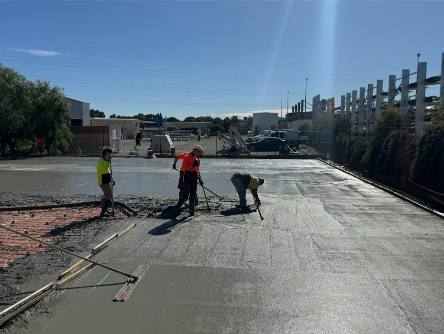
Exposed aggregate concrete Adelaide commercial hardstand
Scope of Work

What the Job Covers

The exposed aggregate process adds stages to what is otherwise a standard concrete pour. Sub-base preparation, reinforcement, and formwork are done to the same standard as any commercial slab. The additional steps — retarder application, wash-down sequencing, and sealing — require careful timing and coordination across the area being poured.

We manage the whole process in-house. The same crew that prepares the sub-base and places the reinforcement is the crew coordinating the reveal. There is no gap between trades and no confusion about who is responsible for which stage. For more on how we work, see the About page.

Aggregate and Mix Design Selection

Stone type, size, colour, and cement paste colour are selected during the planning stage. For large commercial areas, consistency of aggregate supply across multiple concrete loads is an important consideration in what we specify.

Sub-Base Preparation and Formwork

Excavation, sub-base compaction, and edge formwork are completed to the same standard as any commercial slab. Level and drainage falls are set before the pour begins.

Reinforcement Supply and Placement

We supply and lay all reinforcement to the specification required for the intended load. The structural performance of an exposed aggregate slab is identical to standard concrete — the difference is only in the surface treatment.

Concrete Supply, Pour and Retarder Application

We manage the concrete supply and coordinate the pour. Surface retarder is applied uniformly across the fresh slab at the right rate and timing. On large pours, this stage requires careful management across sections to avoid inconsistent exposure depth.

Wash-Down and Aggregate Reveal

Once the bulk of the slab has reached the right strength, the retarded surface paste is washed away to reveal the aggregate. Timing this correctly is critical — too early and the surface is unstable, too late and the paste has hardened beyond the retarder's depth.

Sealing

After curing, exposed aggregate surfaces on commercial sites are typically sealed. Sealing protects the stone and cement matrix, simplifies routine cleaning, and extends the surface life. We discuss sealing as part of the finish specification for each job.

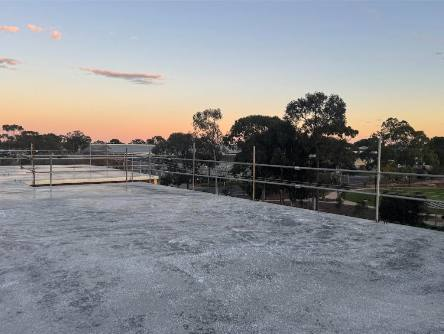
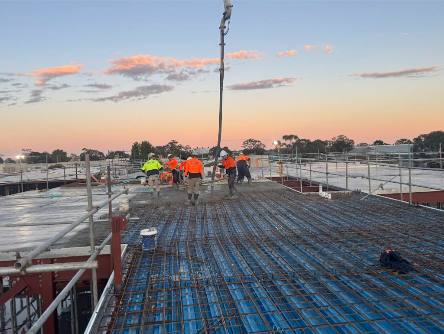
Exposed aggregate concrete pour and retarder application Adelaide Exposed aggregate reveal and finish commercial Adelaide
The Technical Challenge

Getting Consistency Right at Scale

A 20m² residential exposed aggregate driveway and a 1,000m² commercial hardstand use the same basic process. But the variables that affect the result — retarder timing, wash-down sequencing, aggregate distribution between loads — become significantly harder to manage as the area grows.

The most common problems with large exposed aggregate pours are patchy reveal, where some sections show more aggregate than others, and colour or stone variation between concrete loads. Both are avoidable with proper planning and an experienced crew, but both happen regularly when the people doing the work haven't managed a pour at that scale before.

Our team has produced exposed aggregate finishes across large commercial areas across South Australia. The variables listed here are the ones that most directly determine the quality of the result, and the ones we pay close attention to on every pour we do at commercial scale.

Retarder Application Timing

The retarder needs to go on after the bleed water has left the surface but before the concrete sets. On a large pour, this window moves across the slab as work progresses, and keeping up with it consistently determines how even the aggregate depth is across the finished surface.

Wash-Down Sequencing

On a large pour, sections of the slab reach the right strength at different times. Wash-down needs to follow that sequence — starting on the sections that were poured first and moving across the slab in order. Doing it out of sequence produces uneven exposure depth and surface texture.

Aggregate Consistency Between Loads

When a large commercial pour requires multiple concrete trucks, the aggregate gradation and distribution in each load needs to be consistent. Variation between loads shows up as patches of different stone density in the finished surface, which is difficult to fix after the fact.

Crew Coordination Across a Large Area

A large exposed aggregate pour requires more hands and tighter coordination than a standard slab. The crew needs to be working in sequence, not independently, so that the retarder application and the wash-down happen at the right time across the whole area.

Applications

Where Exposed Aggregate Works on Commercial Sites

Exposed aggregate is well suited to commercial surfaces where both appearance and durability matter. The textured stone surface provides natural slip resistance, the finish holds up under heavy use without the wear patterns that can affect coloured or stencilled concrete, and the aesthetic suits a wide range of development types from industrial to retail.

The applications we work on most often are large commercial hardstands, feature pedestrian areas in mixed-use and retail developments, building entries and forecourts, and commercial driveways where a more considered finish is part of the brief. On larger sites it often works alongside standard broom finish in areas where appearance is less critical — managing that transition cleanly is part of how we approach a multi-finish site.

Exposed aggregate is not always the right choice. For purely functional areas like loading docks, internal shed floors, or drainage-critical hardstands, standard broom finish or steel trowel is more practical. For pedestrian footpaths in straightforward commercial settings, broom finish performs well and costs less. We'll tell you if exposed aggregate isn't the right specification for your site, because getting the finish right matters more to us than upselling a more complex process.

Typical Applications

Commercial hardstands
Building entries and forecourts
Feature pedestrian areas
Commercial driveways
Outdoor amenity surfaces
Retail and mixed-use developments
Common Questions

Exposed Aggregate — What Clients Ask

What is exposed aggregate concrete and how is it different from standard concrete?

Exposed aggregate concrete uses the same structural mix as standard concrete, but the surface is treated during the pour to reveal the stone aggregate beneath the cement paste. A surface retarder is applied after the pour to slow the curing of the top layer, which is then washed away once the bulk of the slab has set, exposing the stone. The result is a textured, decorative surface that retains the full structural performance of conventional concrete.

Can exposed aggregate be used on large commercial hardstands?

Yes. We specialise in large-scale exposed aggregate work for commercial hardstands, driveways, and feature surfaces. Achieving consistent aggregate exposure across a large area requires careful coordination of retarder application timing and wash-down sequencing across multiple concrete loads. This is where experience on commercial pours makes a practical difference to the finished result.

How is exposed aggregate concrete sealed and maintained?

Exposed aggregate surfaces on commercial sites are typically sealed after the reveal and curing process. Sealing protects the stone and cement matrix from staining and surface water penetration, and makes routine cleaning easier. The sealer needs to be reapplied periodically depending on traffic levels and exposure conditions. We discuss sealing as part of the finish specification for each job.

What stone and colour options are available for exposed aggregate?

Stone type, size, and colour are selected during the mix design stage. Common options include river pebble, crushed granite, and basalt in a range of sizes. The cement paste colour also affects the overall appearance of the finished surface. We work with the client's brief and the concrete supplier to select a mix that achieves the intended look. For large commercial areas, consistency of supply across multiple loads is an important consideration in the selection process.

What areas of Adelaide do you service for exposed aggregate work?

We service all metropolitan Adelaide regions and take on projects across regional South Australia depending on scope and site access. Contact us to discuss your specific location and project requirements.

Get In Touch

Get a Quote for Exposed Aggregate

Tell us about your project — area size, location, intended use, and any finish preferences — and we'll get back to you to discuss scope and pricing. Or call us on 0428 314 073.

Service Area

All Metropolitan Adelaide regions & regional South Australia